The Iceberg Illusion: Why High-Precision MBO Data Won’t Hand You Financial Freedom
If Market-by-Order (MBO) data can pinpoint institutional iceberg orders with near-surgical accuracy, why doesn’t every day trader use it to achieve financial freedom?
The core premise seems bulletproof at first glance: If you can see the big players hiding their size, you can front-run them or trade alongside them, right?
Wrong.
Seeing your opponent’s cards doesn’t mean you automatically win the hand. In day trading, an analytical edge does not equal an execution edge.
Here is the cold, hard reality of why the vast majority of day traders never touch MBO data—and why it isn’t the golden ticket to early retirement.
1. The Cost and Hardware Paywall
Most retail traders operate on Level 1 (top-of-book quotes) or Level 2 (aggregated market depth). MBO is Level 3 data—the highest fidelity available. It tracks every individual order’s life cycle: additions, queue positions, modifications, cancellations, and fills.
Getting access to that raw data comes with a massive barrier to entry:
- Insane Subscription Costs: CME, Nasdaq, and other exchanges charge hefty direct feed fees. By the time you pay for raw MBO feeds, commercial routing, and specialized charting engines capable of parsing it (such as Bookmap’s higher-tier plans or Sierra Chart’s advanced packages), your monthly overhead can run from several hundred to over a thousand dollars. For most retail accounts, that burns a hole in the PnL before the market even opens.
- Brutal Hardware Demands: When the opening bell rings or high-impact data (CPI, Non-Farm Payrolls) drops, exchanges broadcast hundreds of thousands of queue events per second. Running an unfiltered MBO engine on a standard retail PC will quickly peg your CPU at 100%, freeze your charting platform, or lag your system precisely when you need it most.
2. The Flaw in Logic: Spotting an Iceberg ≠Knowing the Direction
An iceberg order simply reveals where someone wants to accumulate or offload size quietly. It does not tell you where the market will go next.
- Absorption vs. Breakout: If you spot a massive 500-lot buy iceberg sitting at a support level, you might assume it’s an unbreakable floor and go long. But if aggressive institutional sellers decide to hammer that level with market orders, that iceberg can get devoured in seconds. When an iceberg breaks, passive buyers scramble, liquidity vanishes, and price plunges. You get trapped.
- Hedging, Not Directional Bets: Retail traders often assume a massive iceberg represents a firm conviction on where the market is going. Often, it doesn’t. That order could simply be a market maker running a delta-neutral hedge, an options desk rebalancing its book, or an arbitrage algorithm working both legs of a spread. They might not care if that individual futures fill takes heat—because their profit is locked in elsewhere.
- Deception and Spoofing: Institutions know MBO tools exist. Sophisticated algorithmic market makers routinely disguise their intentions by layering liquidity, spoofing queue priority, or manipulating cancel rates to bait retail flow into a trap.
3. The Latency Trap: Bringing a Butter Knife to an HFT Gunfight
Microstructure trading is the native hunting ground of High-Frequency Trading (HFT) firms like Citadel, Jump Trading, and Virtu.
- The Hardware Disparity: HFT algorithms live in co-located data centers right next to the exchange servers in Chicago or New Jersey, connected via nanosecond-latency fiber optic or microwave links.
- The Retail Delay: You, on the other hand, are sitting at home on a standard broadband connection. Between exchange packet broadcast, internet latency, visual engine rendering, human eye processing, and your physical mouse click, your latency is roughly 50 to 200 milliseconds—a literal eternity in modern micro-trading.
By the time you identify an iceberg on your screen and click “Market Buy,” the algorithmic scalpers have already swept the spread, traded against the order, and moved the market. You end up entering late and taking the brunt of the slippage.
4. Cognitive Overload & The Psychology Trap
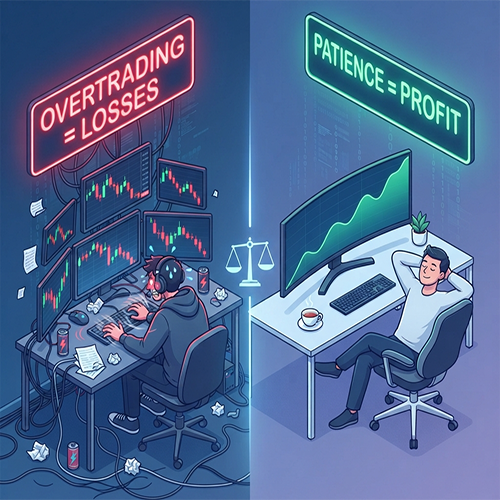
- Drinking from a Firehose: Standard technical indicators (moving averages, VWAP) exist because the human brain prefers smooth, simplified data. MBO does the exact opposite: it floods your screen with raw, unfiltered noise. Watching hundreds of orders flicker and disappear every second leads to extreme analysis paralysis and revenge-trading spirals.
- Data Doesn’t Fix Bad Risk Management: Even if an MBO-based setup delivers a 65% win rate, it will not protect you from blown stops, oversized positions, or emotional tilt. 80% of retail day traders fail not because they lacked Level 3 data, but because they lacked discipline, proper risk-to-reward ratios, and emotional control.
The Bottom Line
MBO data and iceberg detection tools are like an advanced, surgical-grade electron microscope.
In the hands of an elite, institutional order-flow specialist or a quantitative developer, it is a formidable weapon. But for the average retail trader, handed the keys to an F-22 Raptor without flight training, the outcome isn’t soaring to financial freedom—it’s crashing at Mach 2 on the runway.